
Building a Uniform Capsule for Teams With Mixed Work Roles
A single shirt rarely serves every task equally well. A small, controlled uniform capsule can give staff the right garment for desk work, customer contact, loading tasks and outdoor movement while keeping the brand consistent.
In This Article
Direct Answer
Start with roles and exposure, not garment types. Give every employee a core item, then add only the layers or performance pieces required by the tasks they actually perform. This reduces unnecessary SKUs while avoiding the opposite problem: forcing one garment to handle incompatible conditions.
Map the workday before choosing garments
A useful capsule begins with a task map. List where each role spends time, whether the work is air-conditioned or outdoors, how much lifting or walking is involved, and whether customers see the employee. A coordinator who spends six hours at a desk and two hours checking deliveries has different needs from a driver who is outdoors most of the day, even if both belong to the same department. The mistake is to classify both simply as “operations” and issue identical clothing.
A practical rule is to record the hardest 20 percent of each role’s day. If that 20 percent involves heat, rain exposure, dirty handling or repeated movement, the capsule needs an item that deals with it. The everyday core can still be a polo or T-shirt, but the exception garment prevents discomfort and premature wear. This role-first method also gives procurement a defensible reason for why one team receives a jacket or dry-fit option while another does not.
Use a core-plus-module structure
The simplest capsule has a core garment shared by most staff and modules added by role. For example, everyone may receive three polos, warehouse staff may add two lightweight dry-fit tees, and mobile staff may add one light jacket. That creates consistency without pretending every job is identical. It also makes reordering easier because the highest-volume item remains common across departments.
A basic allocation can be calculated from laundry frequency. If staff work five days a week and normally wash uniforms twice weekly, three core tops usually provide one worn, one clean and one in wash or reserve. For a 40-person team, that is 120 core tops before size spares. Add a 5–8% size buffer only to the common items rather than to every specialised garment; otherwise a small capsule quickly turns into a large stockholding exercise.

Keep colour and branding consistent while materials change
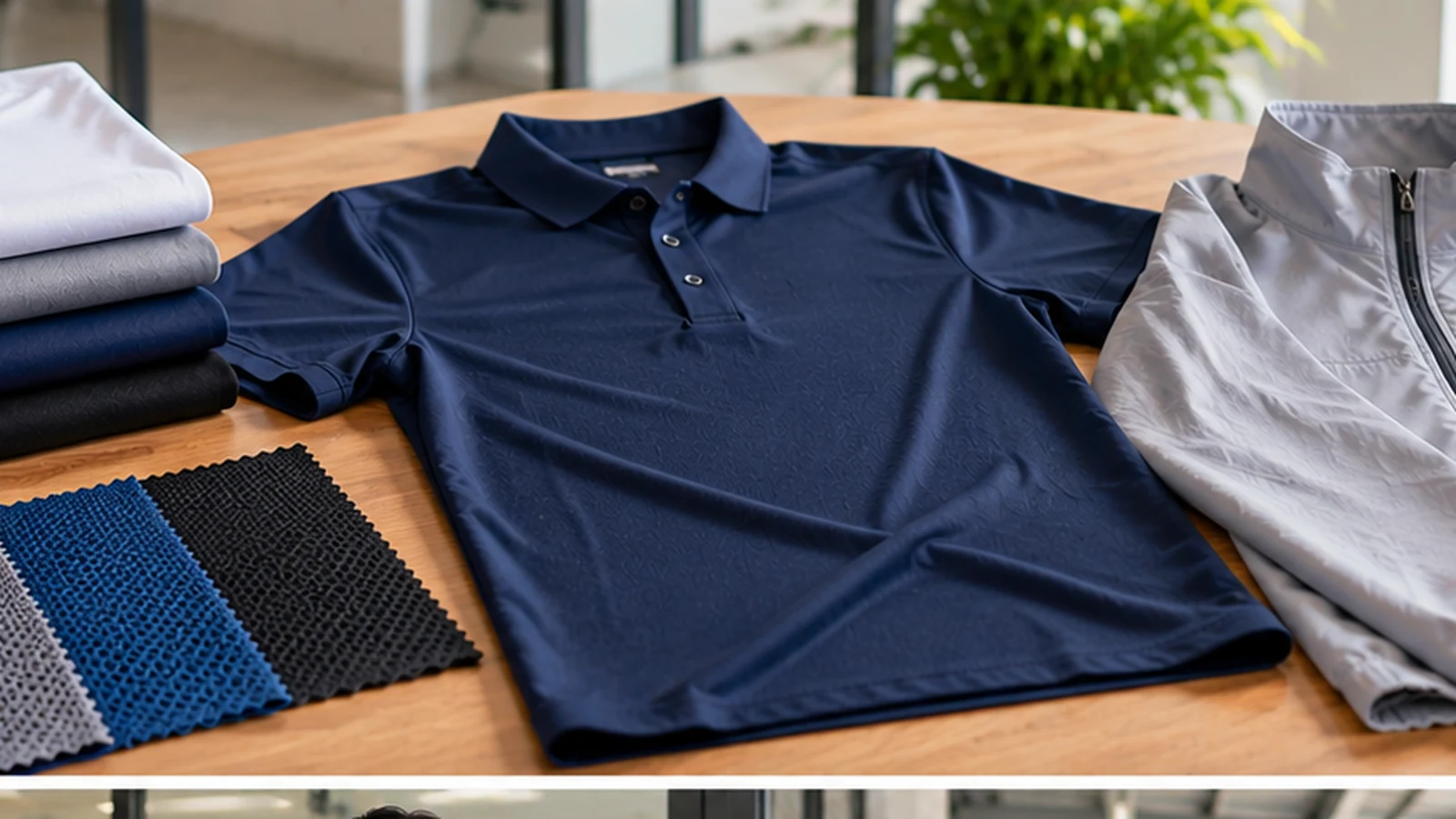
A capsule does not need every garment to use the same fabric. Visual continuity can come from colour family, logo position, trim and silhouette while the textile changes according to use. A navy office polo, navy performance tee and navy lightweight jacket can read as one system if the shades are approved together and the branding scale is controlled. This is especially useful in Singapore, where indoor air-conditioning and outdoor humidity can exist within the same employee’s shift.
Colour matching should be judged physically, not only on screen. Polyester, cotton-rich pique and woven jacket fabric reflect light differently, so the same digital colour value will not look identical on each surface. The goal is a controlled family, not an impossible promise of perfect material-to-material sameness. Approve the garments side by side under neutral light before bulk branding.
| Work condition | Core choice | Possible module | Reason |
|---|---|---|---|
| Mostly indoor/customer-facing | Polo or corporate shirt | Light jacket | Professional appearance with an optional layer |
| High movement/heat | Dry-fit tee or polo | Spare performance top | Faster moisture handling and easier rotation |
| Warehouse/loading | Durable tee or polo | Light outer layer | Movement and abrasion matter more than formality |
| Mixed office/field | Polo | Performance tee + jacket | One visual system across changing conditions |
Control the SKU count before it controls you
Every extra style multiplied by colour, size and gender cut creates inventory complexity. Suppose a company uses four garment styles, two colours and eight sizes: that is potentially 64 stock combinations before considering personalised names. Reducing the system to three styles and one main colour cuts that to 24 combinations, a major difference for storage and replenishment. The arithmetic matters because slow-moving fringe sizes can tie up budget long after the launch.
Set a threshold for adding a new garment: it should solve a documented task problem for a meaningful group, not simply provide variety. Keep specialised pieces generic enough to reassign where possible, and record the approved product code, colour and decoration specification. A capsule works best when it is treated as a controlled range rather than a seasonal fashion collection.
A good uniform capsule reduces variation where variation adds no value, and adds options only where the job genuinely changes.
Frequently Asked Questions
Does every employee need every item?+
No. Issue the common core broadly, then assign modules by role or exposure.
How many tops should a five-day employee receive?+
Three is a useful starting point when laundering happens during the week, but shift pattern and wash access should decide the final quantity.
Should all capsule garments be the same fabric?+
No. Keep the visual language consistent while choosing fabrics appropriate to each task.
Planning a multi-role uniform range?
JCP can help compare polos, T-shirts, dry-fit garments, corporate shirts and light outerwear, then apply consistent embroidery or print specifications.
Discuss Your Uniform Range