
Sublimation Colour Proofing for Multi-Panel Uniforms
Learn how to check sublimation gradients, seam transitions and fabric colour across front, back and sleeve panels before bulk production.
Sublimation makes it possible to build an entire visual identity around a shirt rather than placing one logo on a blank garment. But a front-panel mock-up cannot confirm how a gradient behaves once the fabric is printed, cut and sewn. Colour proofing must consider the whole garment.
Separate digital colours from final fabric colours
Screens emit light while printed fabric reflects it. The fabric base shade, polyester content, print profile and heat process can change the appearance of gradients. For brand-critical colours, ask the printer which reference system or sample swatch they can realistically match.
A digital Pantone reference may guide communication, but it is not a promise of identical fabric colour. Keep an approved physical sample for future comparison.
Plan transitions at seams
A continuous graphic across front, back and sleeve pieces needs intentional alignment. The physical seam allowance, pattern grading and fabric stretch can disrupt perfectly straight lines. Move important wording away from places that may be folded, stitched or covered by collar construction.
Request a flat artwork preview of every panel plus a garment mock-up. They answer different questions: the flat layout checks production areas while the mock-up checks the overall appearance.
Check logos and small details
Keep logos clear of complex high-contrast patterns. Lettering must remain readable when printed on textured fabric and viewed from normal standing distance. White text on a highly saturated patterned field may need a quiet contrast zone to avoid visual noise.
Approve names, numbers and sponsor marks separately where each wearer receives personalised artwork. Avoid last-minute additions once panel positioning is fixed.
Give production a final signed proof
The approved file set should name the fabric, garment cut, size grading, print dimensions, panel orientation and logo references. Order one representative sample if practical, then review it in natural and indoor light.
If changes are required, identify exactly which panel and artwork version changed. This prevents an older sleeve or collar print file from reappearing in the production run.
Quick comparison before placing an order
| Decision | What to consider | Approval check |
|---|---|---|
| Digital mock-up | Overall design direction | Does not guarantee exact printed colour |
| Flat panel artwork | Bleed, seam and placement review | Needs garment construction awareness |
| Physical sample | Colour, fit and assembly confirmation | Use as approved reference |
How JCP services fit this order
For product specifications and appropriate customisation, review the relevant JCP product or service page. Its process and product examples can help you prepare a clearer quotation request. Availability, method, minimum quantity and delivery should be confirmed for your exact destination and order rather than assumed from a general guide.
See UniformSarawak’s website for the destination brand and its current information. To share the final requirement directly with JC Print & Office, use the official JCP contact page. This article is informational and does not imply an operational Singapore or Sarawak showroom.
Frequently asked questions
Can sublimation create gradients?
Yes, suitable polyester-based fabrics accept detailed full-colour designs.
Why can front and sleeve graphics appear slightly misaligned?
Seam allowances, size grading, cutting and sewing introduce physical tolerances.
Is one RGB file enough for manufacturing?
Ask the producer for required file formats, panels, resolution and colour references before final sign-off.
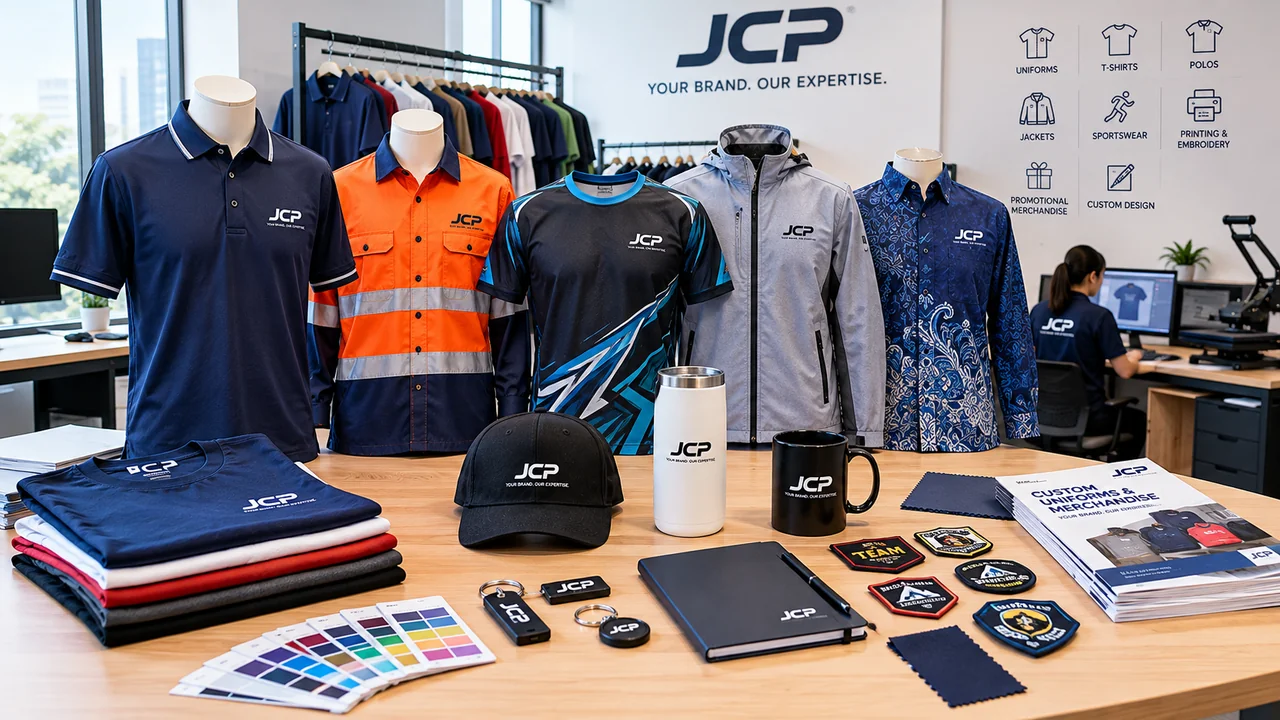
Illustrative AI-generated imagery. Service/product information cross-checked against publicly retrievable JCP pages on 21 October 2026. Images are local ZIP assets; live media URLs shown in HTML are placeholders until upload. Website domains shown above require site-side validation.