
Sleeve Logo Placement: Measure Around the Arm, Not From a Flat Mock-Up
Sleeve branding is easy to misplace because a sleeve is a curved tube, not a flat rectangle. A logo that looks centred on a digital front view can rotate toward the chest or back once the garment is worn, especially across different sizes.
In This Article
Direct Answer
Set sleeve placement on a worn garment and use repeatable garment landmarks. Measure from the shoulder seam and sleeve hem, then confirm the logo sits on the visible outer arm rather than simply in the middle of the flat sleeve panel. Approve the position on more than one size before production.
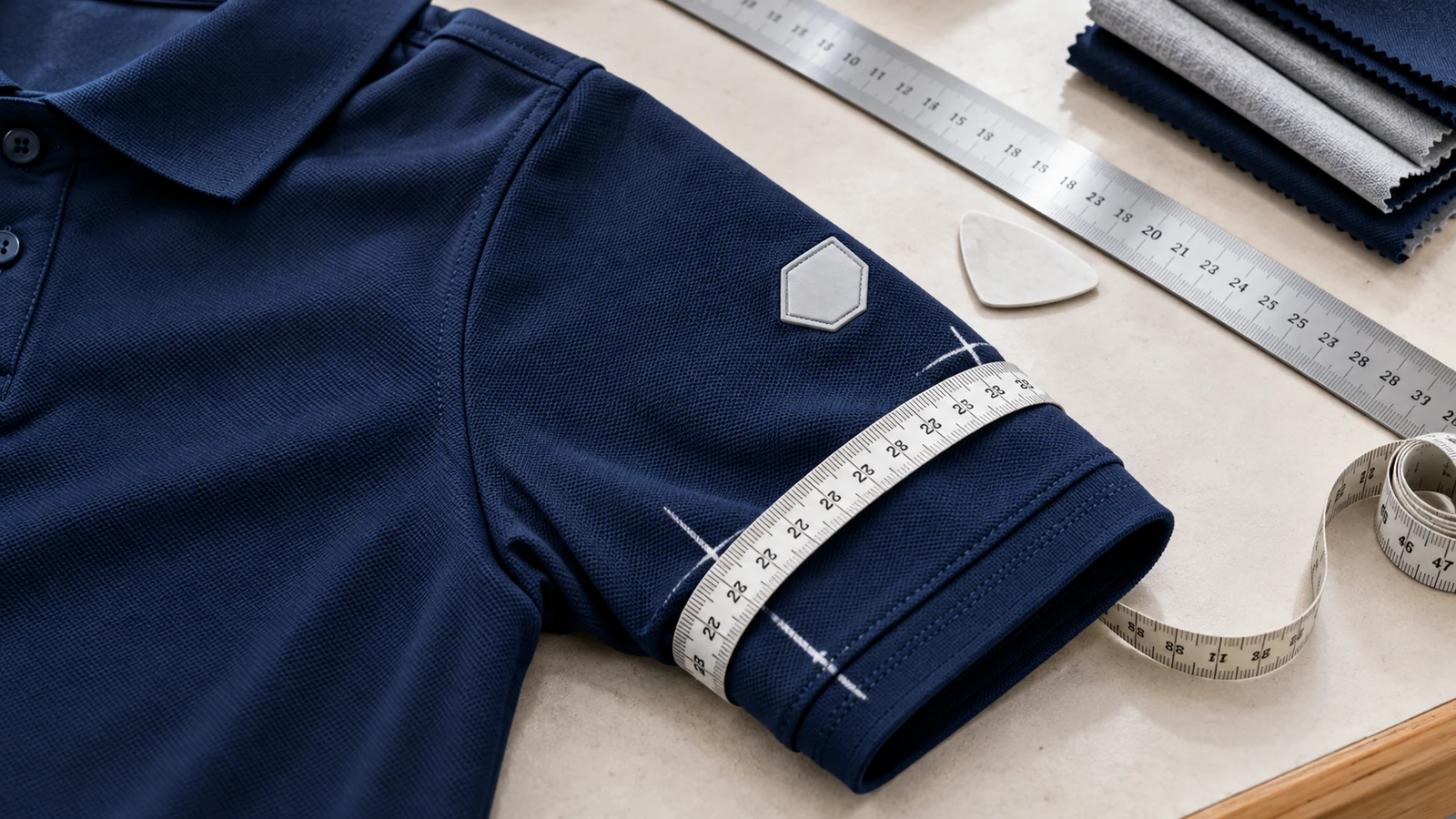
The sleeve rotates when it wraps around the arm
On a flat polo, the sleeve panel appears wide and symmetrical. Once worn, the front portion rolls toward the chest and the back portion rolls away from view. The true visible centre is therefore not always the centre of the flattened panel. A logo positioned by eye on a mock-up may end up facing too far forward, especially on fitted sleeves.
This matters for sponsors, certification marks, department identifiers and any branding expected to be visible in photographs. The fix is not a universal centimetre value; it is a physical placement test on the actual garment model.
Use landmarks production can repeat
Choose references that exist on every shirt: the shoulder seam, sleeve hem and centre line of the outer arm. Measure the logo centre or top edge from those references and record the result. Avoid instructions such as “a little below the shoulder” because different operators will interpret them differently.
If the logo is embroidered, also consider hoop access and seam thickness. If it is heat applied, confirm the sleeve can sit flat enough on the press without the shoulder seam or sleeve hem creating uneven pressure.
| Check | Why it matters | Practical method |
|---|---|---|
| Shoulder seam distance | Controls vertical position | Record top edge or centre distance |
| Outer-arm rotation | Controls what faces the viewer | Approve on a worn garment |
| Sleeve hem clearance | Prevents crowding | Leave a consistent visual gap |
| Size range | Placement can shift | Test small and large sizes |
Check at least a small and a large size
A fixed placement can shift visually as sleeve length and circumference change across the size run. On a small shirt, the same logo may sit close to the hem; on a large shirt it may look too high. The logo itself may also need one consistent size for operational simplicity, even when the garment grows around it.
Test the proposed placement on at least two sizes at opposite ends of the main staff range. If the difference becomes distracting, define a second placement rule for larger sizes rather than forcing one measurement onto every garment.
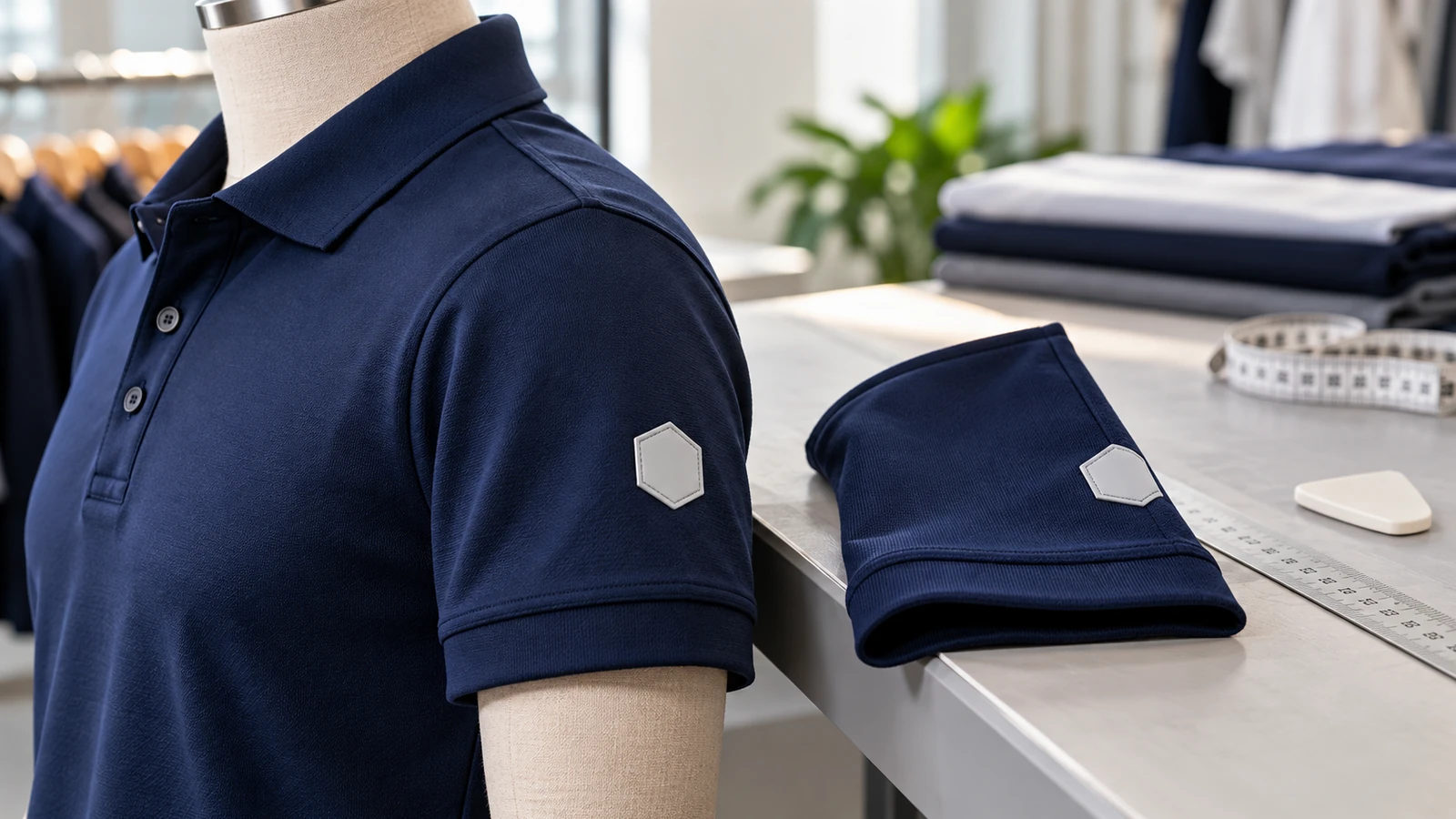
Keep clear of seams, cuffs and other details
Sleeve piping, contrast panels, reflective strips and cuff bands can reduce the usable branding zone. A logo that overlaps these features may look visually crowded or create production difficulty. Leave enough breathing room that the logo reads as intentional rather than squeezed into the remaining space.
For long sleeves, also consider how the mark behaves when sleeves are rolled or pushed up. If the team commonly rolls sleeves, a low placement may disappear entirely during normal work.
Approve the sleeve while someone is wearing it
Put the sample on a wearer, let the arm hang naturally, then view it from the side, front three-quarter and rear three-quarter angles. Check whether the mark remains visible where the business expects it to be seen. Photograph the approved position and keep the measurement with the artwork file.
That small record becomes valuable on repeat orders because the next batch can be set from the same garment landmarks instead of relying on a fresh visual guess.
The centre of a flat sleeve is not automatically the centre of the visible arm.
Frequently Asked Questions
Can I use the same sleeve position for every size?+
Sometimes, but verify it on the smallest and largest common sizes before assuming one rule works.
Is sleeve embroidery harder than chest embroidery?+
It can be, because sleeve seams and limited hoop access reduce the flat working area.
What should be recorded after approval?+
Keep the garment model, logo size, shoulder/hem measurements and a photo of the worn sample.
Adding Branding to Shirt Sleeves?
JCP can review logo size, placement and the selected decoration method before production.