
Planning Food Product Labels for Sarawak Retail and Wider Market Access
For Sarawak food producers moving from small-batch sales into retail, trade fairs or distribution, label design needs to support both brand identity and controlled product information. The print workflow should make market-specific revisions easier, not riskier.
In This Article
Direct Answer
Build the label as a controlled system: confirm the current Malaysian food-labelling requirements for the product, reserve a stable information zone, test the label on the real package, and maintain separate approved artwork versions for each market and SKU. Printing is the final execution step, not the compliance decision.
Why label planning matters before a Sarawak product scales
Sarawak food businesses often begin with a product story that is strongly tied to place, ingredients and local identity. As the product moves from direct sales into retail, trade fairs or distribution, the label also becomes an operational document. Malaysia’s Ministry of Health states that food labels must comply with the Food Act 1983 and Food Regulations 1985, and its Food Safety and Quality Programme provides label-review services for industry. That means visual branding and regulated information need to be managed together but approved for different reasons.
The market-access context is real rather than hypothetical. In May 2026, MINTRED brought Sarawak food and beverage businesses to MYFOOD Expo, and Sarawak exhibitors also appeared at Food & Hospitality Asia in Singapore. Those programmes show why a small producer may suddenly need packaging that works beyond a weekend market table. A label system should therefore be built so that mandatory information, pack size and market-specific requirements can be revised without rebuilding the entire brand from scratch.
Create a fixed information zone and a flexible brand zone
Separate the pack into two design layers. The brand zone carries the product identity, visual pattern, photography and story. The information zone is reserved for regulated declarations and other practical product data. This prevents decorative elements from consuming the space later needed for ingredients, net quantity, business details, date information or other required statements relevant to the product.
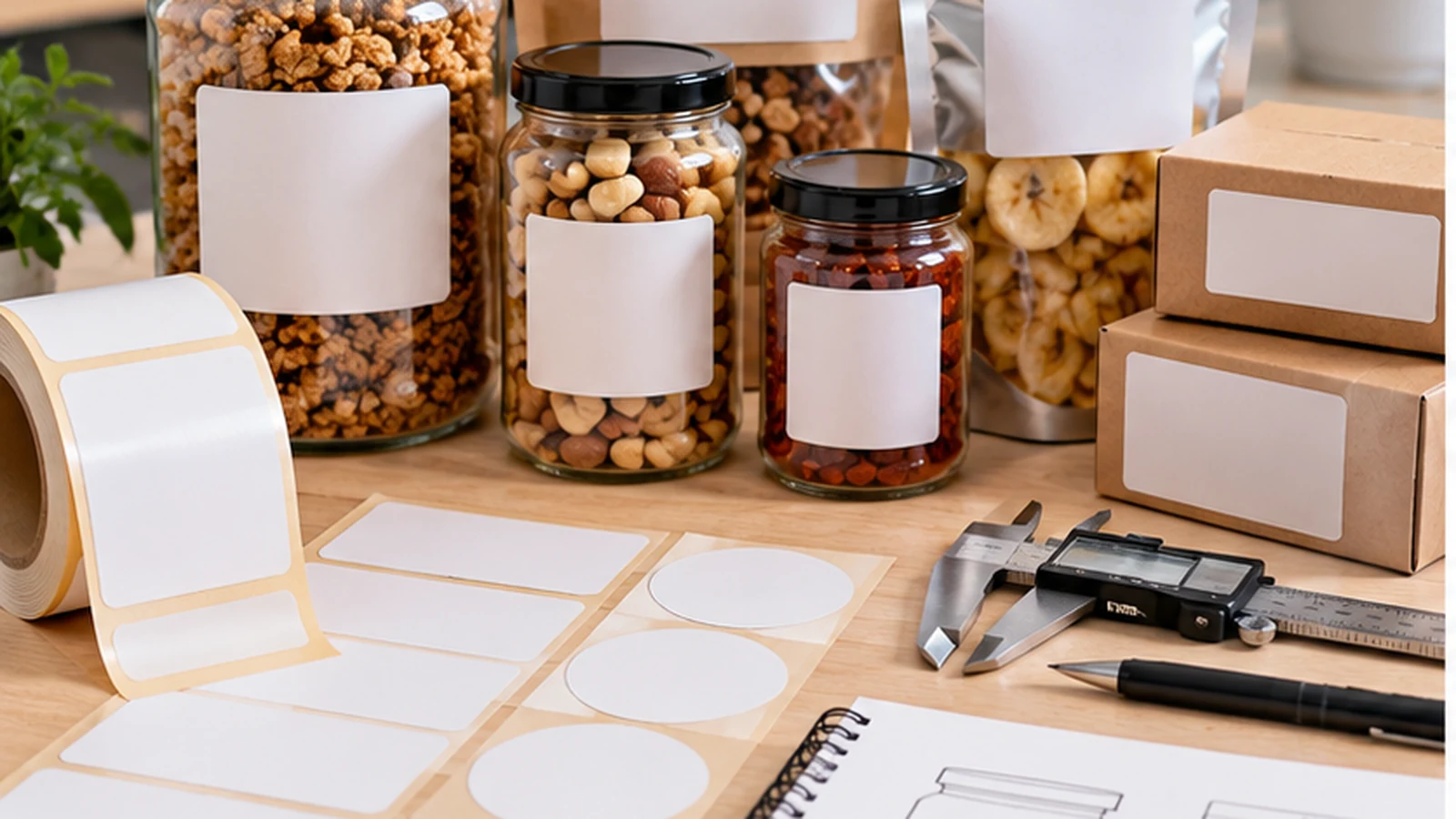
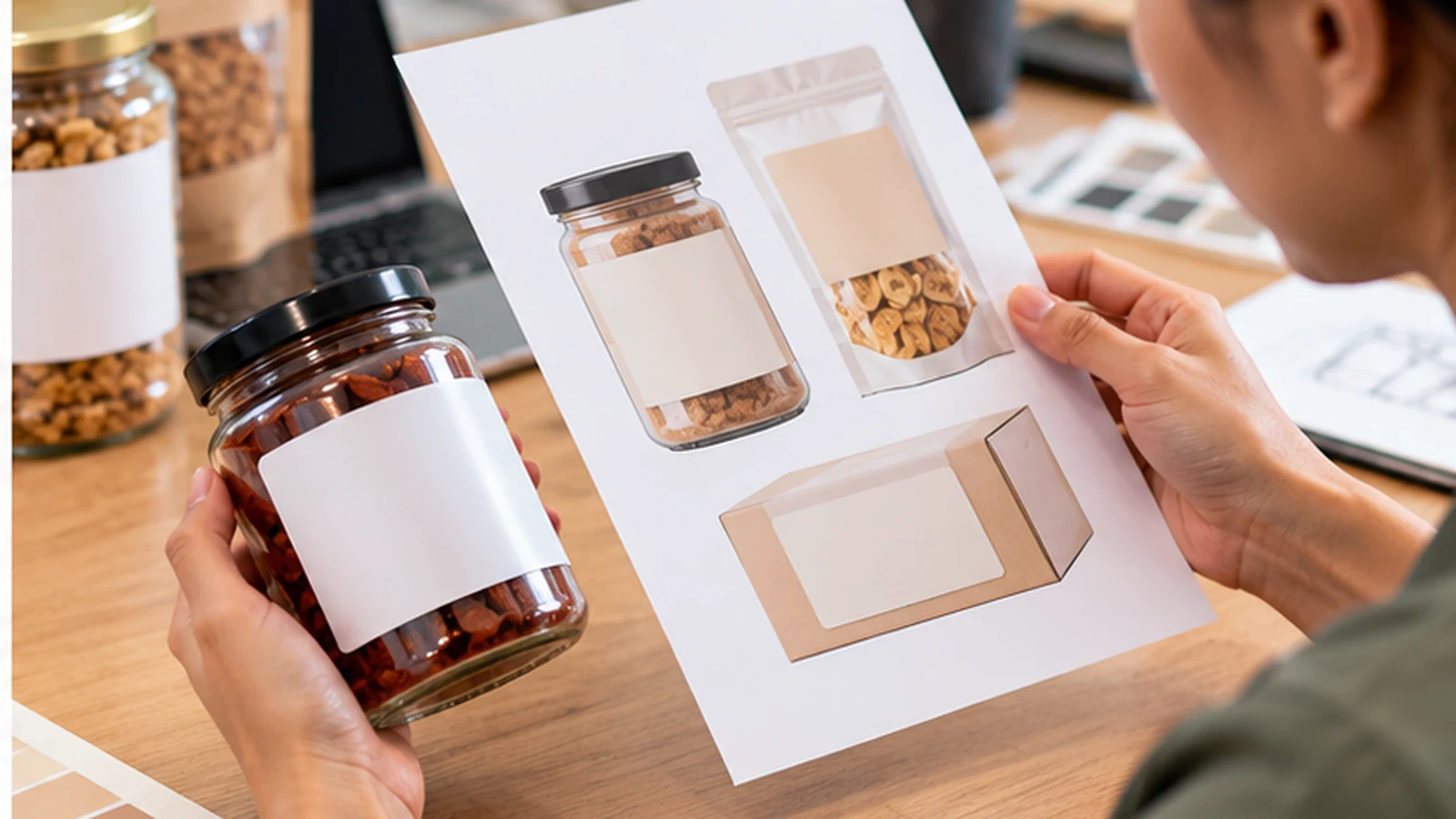
For small-batch products, a base pouch or box plus a professionally printed label can be practical because it reduces the number of fully preprinted packaging variants. The label still needs enough area for legibility and must suit the package surface. A narrow curved jar, flexible pouch and paper box may require different label proportions even when they share one visual identity. Prototype the physical pack before ordering volume.
Treat every market expansion as a version-control event
A product prepared for local Malaysian sale may need different information or commercial presentation when it enters another market. Do not overwrite the master artwork and assume one file can serve every destination. Keep a controlled version for each market, pack size and flavour, with a revision date and approval owner. That is especially important when distributors or trade-event teams request last-minute stickers.
Malaysia’s Ministry of Health offers an optional food-label review service and states that labels must comply with the Food Regulations 1985. In September 2026, the Ministry’s food-safety portal also listed newly gazetted amendments, illustrating why businesses should work from current regulatory material rather than an old packaging template. Printing should begin only after the responsible business has confirmed which version is approved for the intended market.
Use Sarawak identity without crowding the legal information
Local identity can be a strong commercial asset, but it should not reduce readability. Ingredients such as pepper, sago, dabai or other Sarawak-associated foods may be central to the product story, yet the consumer still needs a clear hierarchy. Avoid turning every available surface into decorative pattern. White space around information can make a small package look more deliberate and make mandatory details easier to find.
If batik-inspired graphics, indigenous-inspired geometry or regional motifs are used, obtain appropriate design rights and cultural guidance where necessary rather than treating local visual language as generic decoration. Keep the production file organised so the visual layer can evolve without accidentally moving or deleting approved information. Good packaging is not a contest between compliance and branding; it is a layout system that gives both a defined place.
A practical release sequence
A release sheet does not need to be complicated. It should identify the product, pack size, intended market, artwork revision, print quantity and person who approved the information. The purpose is to stop a visually similar but obsolete label from reaching production. This becomes more valuable as a producer adds flavours, gift packs or distributor-specific requirements.
For a business with five products in two pack sizes, there are already ten possible label files. If two markets require different versions, that can become twenty. A simple naming and approval convention is cheaper than discovering the wrong version after thousands of labels are printed.
| Stage | Decision | Failure to avoid |
|---|---|---|
| Product information | Confirm current Malaysia requirements for the product | Designing around incomplete declarations |
| Pack prototype | Measure the actual container or pouch | Assuming a flat label fits every surface |
| Market version | Assign market/SKU/revision owner | Overwriting one master file for all destinations |
| Print release | Approve physical proof and quantity | Bulk printing before content is locked |
Current reference points
Malaysia’s Ministry of Health Food Safety and Quality Programme states that the Food Regulations 1985 set comprehensive food-labelling requirements and provides optional label-review services. Its regulatory portal listed amendments gazetted in 2026, including updates published in September. Separately, Sarawak government reporting documented MINTRED-supported food businesses at MYFOOD Expo 2026 and Sarawak exhibitors at Food & Hospitality Asia 2026, providing a current market-access reason for producers to manage packaging versions carefully.
Businesses should verify the rules that apply to their specific food and target market before printing. Useful official starting points are the Ministry of Health’s Food Safety and Quality Programme and Sarawak government/MINTRED communications.
A scalable food label is not one fixed artwork; it is a controlled system that can change market information without losing the product’s visual identity.
Frequently Asked Questions
Does Malaysia provide a food-label review service?+
Yes. The Ministry of Health’s Food Safety and Quality Programme publishes food-label review and advisory services for industry.
Should the same artwork file be used for every market?+
Not automatically. Keep controlled market-specific versions when requirements or commercial information differ.
Can local visual identity still be prominent?+
Yes, but reserve clear space for required information and use culturally appropriate, properly authorised design elements.
Need approved packaging labels printed?
UniformSarawak can support sticker and packaging-related print production once your product information, dimensions and approved artwork version are ready.
Discuss Label Printing