
Corporate Polo Shrinkage Tests Before You Confirm a Reorder
A polo that fits well on the first order can become a headache on the second if nobody checked shrinkage behaviour properly. Before you reorder, it is worth testing how the fabric changes after washing, how much movement is still acceptable, and whether the pattern, collar and placket still behave the way your team expects.
In This Article
- Why shrinkage causes reorder problems
- A practical test method buyers can use
- What tolerance is usually acceptable
- When to stop a reorder and review the specification
Direct Answer
A polo that fits well on the first order can become a headache on the second if nobody checked shrinkage behaviour properly. Before you reorder, it is worth testing how the fabric changes after washing, how much movement is still acceptable, and whether the pattern, collar and placket still behave the way your team expects.
Why shrinkage causes reorder problems
Many teams assume that a repeat order only needs the same colour and the same size chart, but shrinkage can quietly change how the garment feels in real use. A polo that loses length after washing can expose the waistband when staff bend or reach, while a collar that tightens slightly can make the whole shirt feel smaller even if the chest is technically still within tolerance. These issues become expensive when a reorder is already distributed to multiple staff members, because the problem is then operational rather than theoretical. Another common issue is that the first batch may have been tested casually at sample stage, while the reorder relies only on the supplier saying the fabric is the same. In practice, fabric lot changes, finishing differences and small construction changes can alter the result. That is why shrinkage should be treated as part of reorder quality control rather than a one-time sampling exercise.
A practical test method buyers can use
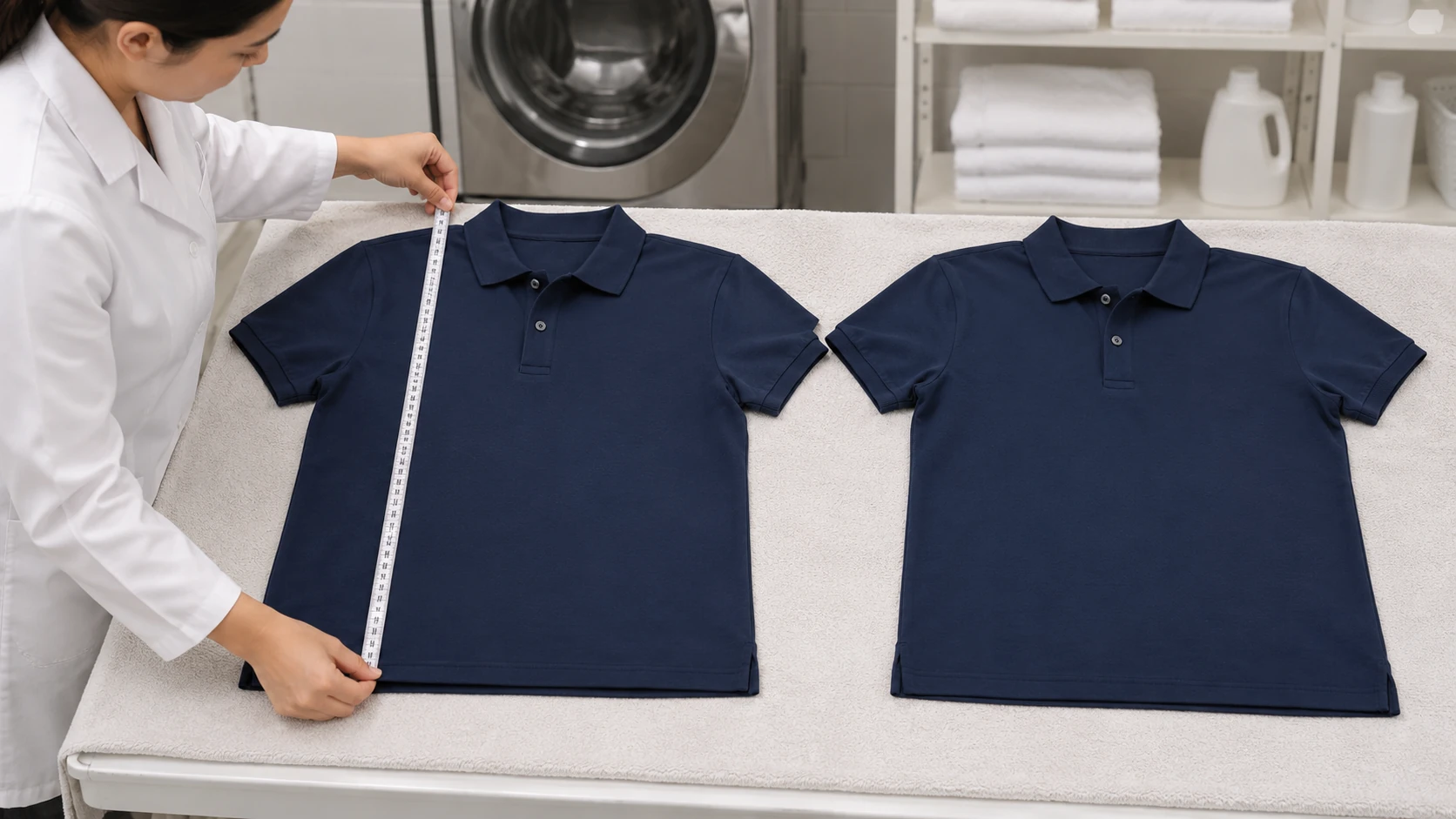
The simplest usable system is to take one approved shirt, record key flat measurements, wash it according to the expected care method, then measure it again. At minimum, record chest width, body length, shoulder width and sleeve length. If the garment will be used in a high-turnover environment, such as retail or F&B, it is safer to run more than one cycle because that reflects real use better than a single wash. Buyers should also look beyond numbers. Check whether the placket twists, whether the side seams pull forward, whether rib collar shape is still neat and whether the hem remains level. A supplier may tell you that the shrinkage is within spec, but if the shirt still looks visibly distorted, the reorder should not pass as a routine repeat.

What tolerance is usually acceptable
Tolerance should be decided before production, not after a dispute appears. For many standard uniform programs, buyers often work within a modest range such as around 2% to 3% for core flat measurements, but the real answer depends on the fabric type, fit intent and staff expectations. A slim corporate polo with a short body length gives less room for movement than a relaxed event polo. It is also useful to set a decision rule. For example, if the body length and chest remain within agreed tolerance but the collar becomes visibly wavy or the placket puckers, the sample still fails. This approach prevents the supplier from reducing quality control to one passing number. It also makes approval faster because everyone knows what constitutes a pass, a conditional pass or a reject.
When to stop a reorder and review the specification
If the new sample behaves differently from the approved batch, do not rush straight into full production just because the staff need the shirts soon. Pause and review the fabric composition, GSM, knitting style, finishing treatment and care instructions. Sometimes the answer is as simple as changing the wash-care guidance or allowing slightly more garment length in production. In other cases, the issue points to a bigger mismatch between the original sample and the current fabric source. The useful habit is to keep one approved physical control sample and the recorded measurement sheet from the earlier batch. That gives you an objective reference when the supplier says everything is unchanged but the sample tells a different story.
Quick Comparison Table
| Checkpoint | Why it matters | Action |
|---|---|---|
| Body length | Shortening is immediately noticeable in wear | Measure before and after wash; compare against approval tolerance |
| Chest width | A small reduction can make team sizes feel tight | Check flat chest and compare with live fit expectations |
| Collar and placket | Distortion affects appearance even if size is acceptable | Inspect visually after wash, not just by number |
| Sleeve opening and shoulder | These affect mobility and uniform appearance | Check measurement and wearer comfort together |
Key Takeaway
A reorder is safest when it is anchored to three things together: an approved physical sample, a recorded measurement sheet and a repeatable wash-test method. Relying on memory or an old quotation is usually what causes preventable disputes.
Frequently Asked Questions
Should we wash every reorder sample?
If the garment is meant for real daily wear, yes. A quick wash test is far cheaper than replacing a whole reorder batch.
Is one wash enough?
One wash is the minimum. For harder-use uniforms, more than one cycle gives a more realistic picture.
Can we approve by size chart only?
Not safely. A size chart tells you intended measurement, but not how the finished fabric behaves after washing.
Need Help With This Type of Order?
If you need help planning repeat polos, sampling or garment quality checks before production, talk to JCP through our contact page.
Contact JCP