
When Multipart Forms Still Make Operational Sense
Digital records are useful, but some handovers still happen at a loading bay, customer site or counter where two parties need an immediate copy. Multipart carbonless forms can remain practical when the paper copy is part of the control process rather than a habit.
In This Article
Direct Answer
Use multipart forms when the transaction needs simultaneous copies, a signature or handwritten exception at the point of handover, and the environment makes a digital workflow inconvenient. Do not print them simply because the old form has always existed.
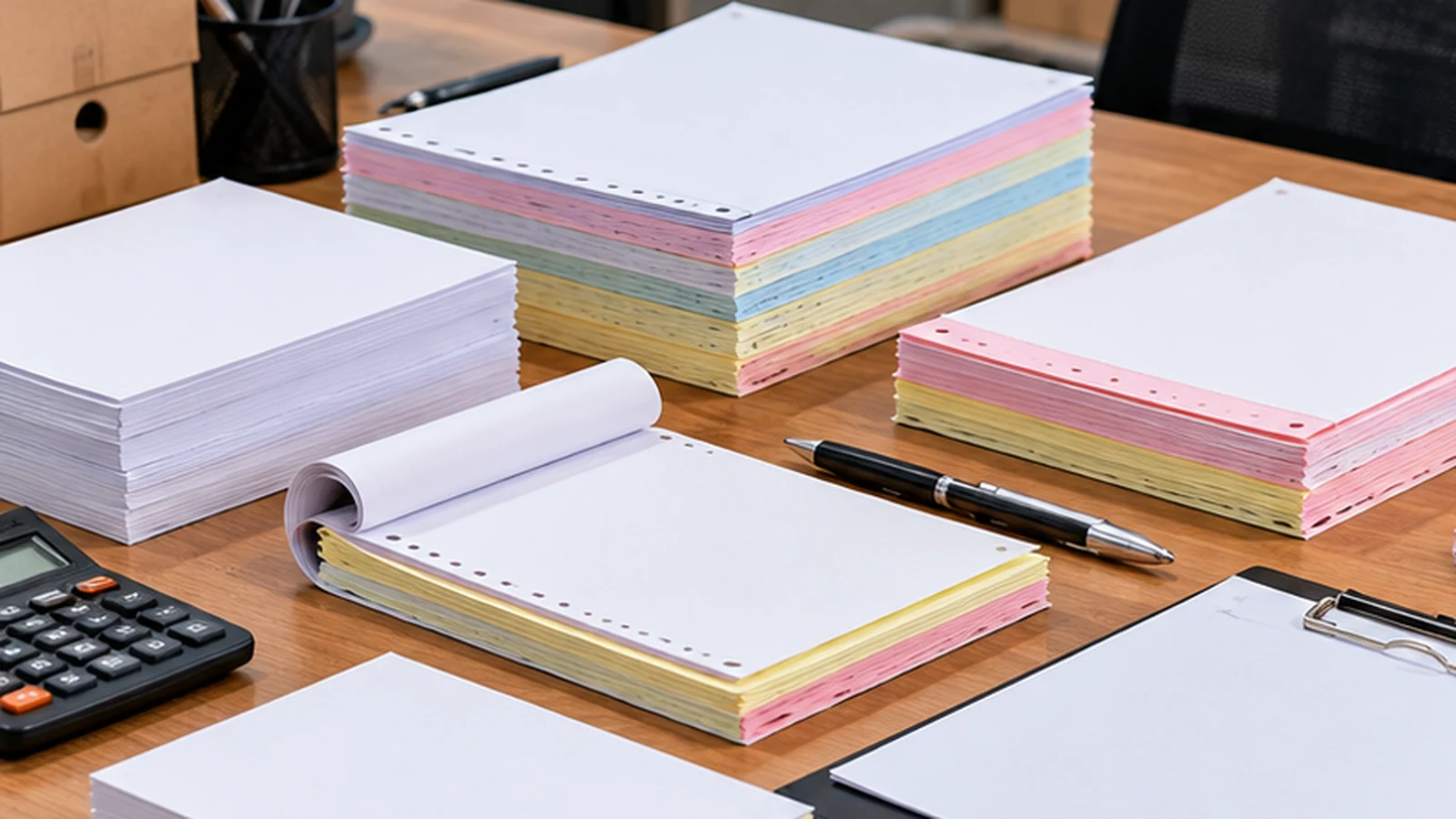
Identify the moment that actually requires two copies
The strongest case for a multipart form is a physical handover. A driver delivers goods, a customer signs for quantity received, one copy stays with the customer and another returns with the driver. A service technician records work completed and leaves a copy on site. A warehouse issues stock to another department and both sides need the same handwritten record immediately. In these cases, the duplicate is created at the same moment rather than re-entered later.
If nobody needs the second copy at the point of transaction, multipart paper may be unnecessary. A normal printed form, digital form or generated PDF could be simpler. Map who writes, who signs, who keeps each ply and where the record goes next. That workflow test is more useful than asking whether carbonless forms are “old-fashioned.”
Choose the number of plies from custody, not preference
Two-part forms are enough when there are two record owners: for example, customer and office. Three-part forms make sense when a third party such as warehouse, accounts or driver needs a retained copy. Adding a fourth ply without a defined owner increases thickness and cost without improving control. Write the destination of each copy into the process before deciding the form specification.
Colour-coded plies can help staff separate copies quickly, but colour should support the workflow rather than replace labels or training. If the top copy is white, second is yellow and third is pink, document which department receives each one. Keep that mapping stable across reprints. Changing the order casually can create filing mistakes even when the printed content remains identical.

Plan numbering around traceability
Sequential numbering is valuable when forms represent controlled transactions such as delivery orders, collection notes or service jobs. The number gives staff a shared reference for reconciliation and makes missing documents easier to notice. It is especially useful when handwritten names or dates are difficult to read. Numbering does not create control by itself, however; the organisation must decide who issues a book or batch and how unused or voided numbers are handled.
Estimate the print run from actual usage. If a team consumes 35 forms per working day and operates 22 days per month, monthly usage is about 770 sets. A three-month requirement is 2,310 sets; adding a 10% operational buffer brings the planning quantity to roughly 2,540 sets. That calculation is more defensible than ordering 5,000 because it appears to offer a lower unit price, especially if the form contains prices, addresses or terms that may change.
| Question | If yes | If no |
|---|---|---|
| Do two or more parties need a copy immediately? | Multipart may be useful | Consider single-sheet or digital record |
| Is a signature/handwritten exception captured on site? | Paper can simplify handover | Digital may be easier |
| Does each ply have a defined owner? | Choose that number of plies | Remove unnecessary copies |
| Is sequential traceability important? | Add controlled numbering | Plain sets may be enough |
Design for handwriting and field conditions
Forms used on site need generous writing areas, strong field labels and a logical sequence. Tiny boxes may look neat on screen but fail when someone writes with a ballpoint pen while standing beside a vehicle. Important acknowledgement fields should be easy to find. Avoid placing signatures or quantities too close to perforations, binding edges or areas likely to be obscured by a clipboard.
Test the form with the actual writing pressure and number of plies. The final copy must receive a readable transfer without requiring excessive force. If the form will be used outdoors or around dust and moisture, think about book covers, backing boards and storage as part of the system. Good business-form printing is operational design: the paper has to survive the place where the transaction occurs.
The right print run and number of plies come from the transaction workflow, not from tradition or the cheapest unit price.
Frequently Asked Questions
What does NCR mean?+
It commonly refers to no-carbon-required carbonless paper that transfers handwriting to the sheets below.
How many parts should a form have?+
Only as many as there are genuine copy owners in the workflow.
How should print quantity be estimated?+
Use daily or monthly consumption, multiply by the desired coverage period, then add a modest operational buffer.
Need repeat business forms printed?
JCP can produce business forms and other repeat office print once your size, ply count, numbering and quantity are confirmed.
Discuss Business Form Printing