
Workwear Zoning for Industrial Teams in Sarawak: A Practical Colour and Stock System
Industrial teams in Sarawak often combine permanent staff, contractors, technical specialists and visitors across large sites. The challenge is to make roles understandable without creating so many garment variations that branch stock and reorders become difficult to control.
In This Article
Direct Answer
Use the fewest garment colours that support real role identification, keep safety and high-visibility requirements separate from brand styling, and document each approved garment as a controlled SKU. For multi-site operations, a common base garment with limited role markers is usually easier to move between locations than a different colour for every department.
Design for multi-role industrial sites, not office departments
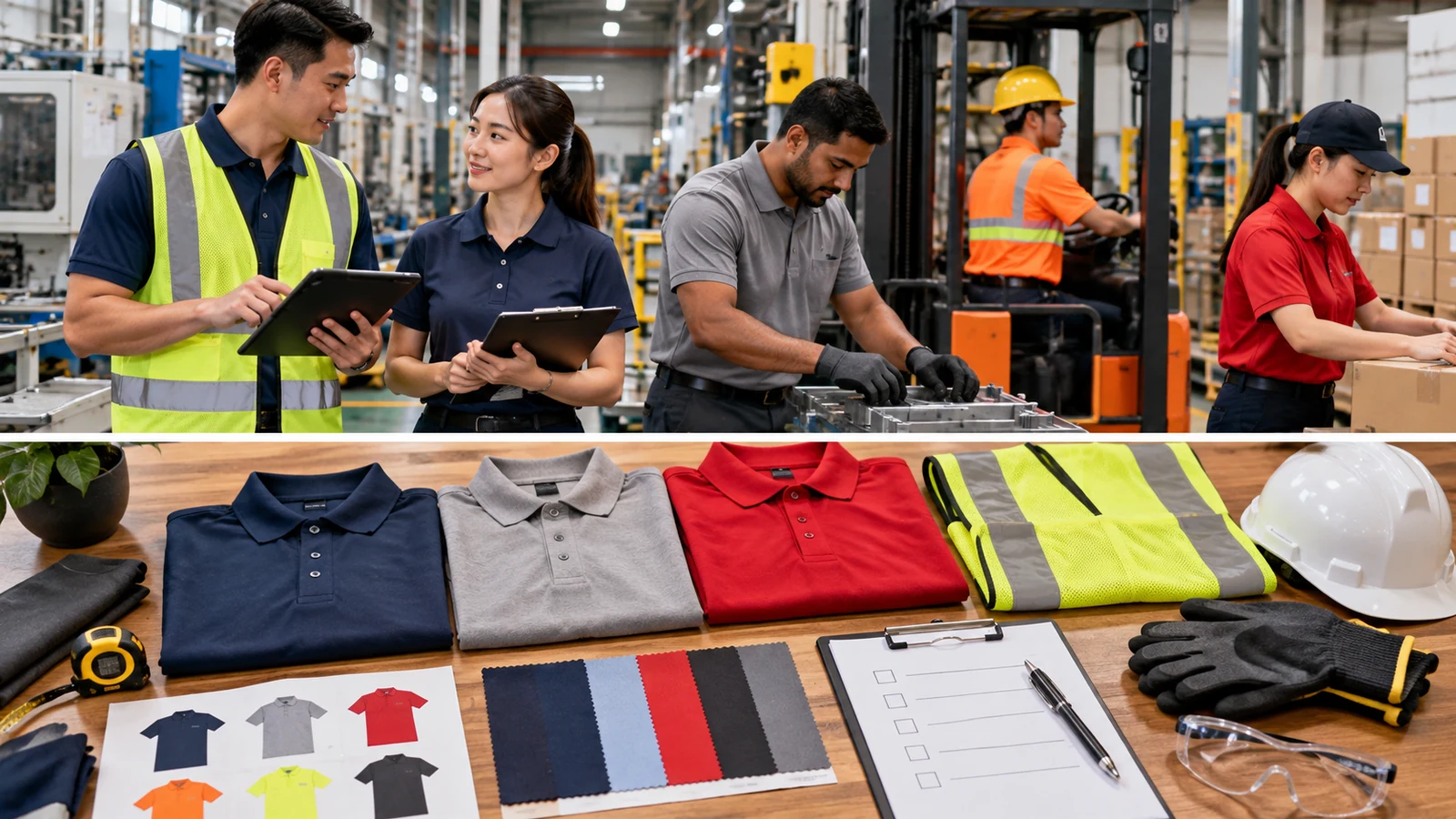
RECODA continues to identify Samalaju Industrial Park as a key industrial hub in the Sarawak Corridor of Renewable Energy, and its September 2026 updates included site-development monitoring and workforce-related engagement in Samalaju. That context matters because industrial uniform systems often have to serve mixed teams, contractors and changing work packages rather than stable office departments.
Start by listing the role distinctions that genuinely change behaviour on site. Supervisors, visitors, maintenance personnel and production operators may need different visual cues; two administrative departments usually do not. When colour is tied to an action, people can learn the system. When colour is tied only to an organisation chart, the system tends to grow faster than its practical value.
Build a stock system that can move between projects
For organisations serving Bintulu, Samalaju or other locations, stock mobility matters. Six sizes across four department colours create 24 size-colour combinations before long sleeves, cuts or personalisation are considered. If one project slows and another grows, surplus garments in the wrong colour may be impossible to redeploy.
A shared navy, grey or other approved base garment can reduce that problem, while role differences can be added through vests, patches or selected accents. The principle is not to make every site look identical; it is to keep the expensive inventory layer reusable. Local identity or project branding can then be applied where it has a clear purpose.
| Need | Low-complexity solution | When a separate garment colour is justified |
|---|---|---|
| Supervisor identification | Different vest or small accent | When rapid identification is frequent and operationally important |
| Department identity | Common polo plus patch/lanyard | When teams work together and colour meaning is consistently used |
| Vehicle-zone visibility | Specified high-visibility layer | Use safety-driven specification, not brand colour alone |
Keep protective requirements outside the branding argument
Industrial workwear may need visibility, protective construction or site-specific PPE depending on the task and hazard assessment. Those requirements should not be replaced by a bright corporate polo simply because the colour appears conspicuous. Procurement documents should state clearly which item is the uniform and which item is safety equipment.
This separation helps supervisors too. If a high-visibility vest has a defined safety role, it should not be treated as an optional department colour. Likewise, a branded shirt should not be assumed to provide protection it was never specified to provide. Clear categories reduce substitution errors when stock is issued under time pressure.
Use one specification sheet across branches and contractors
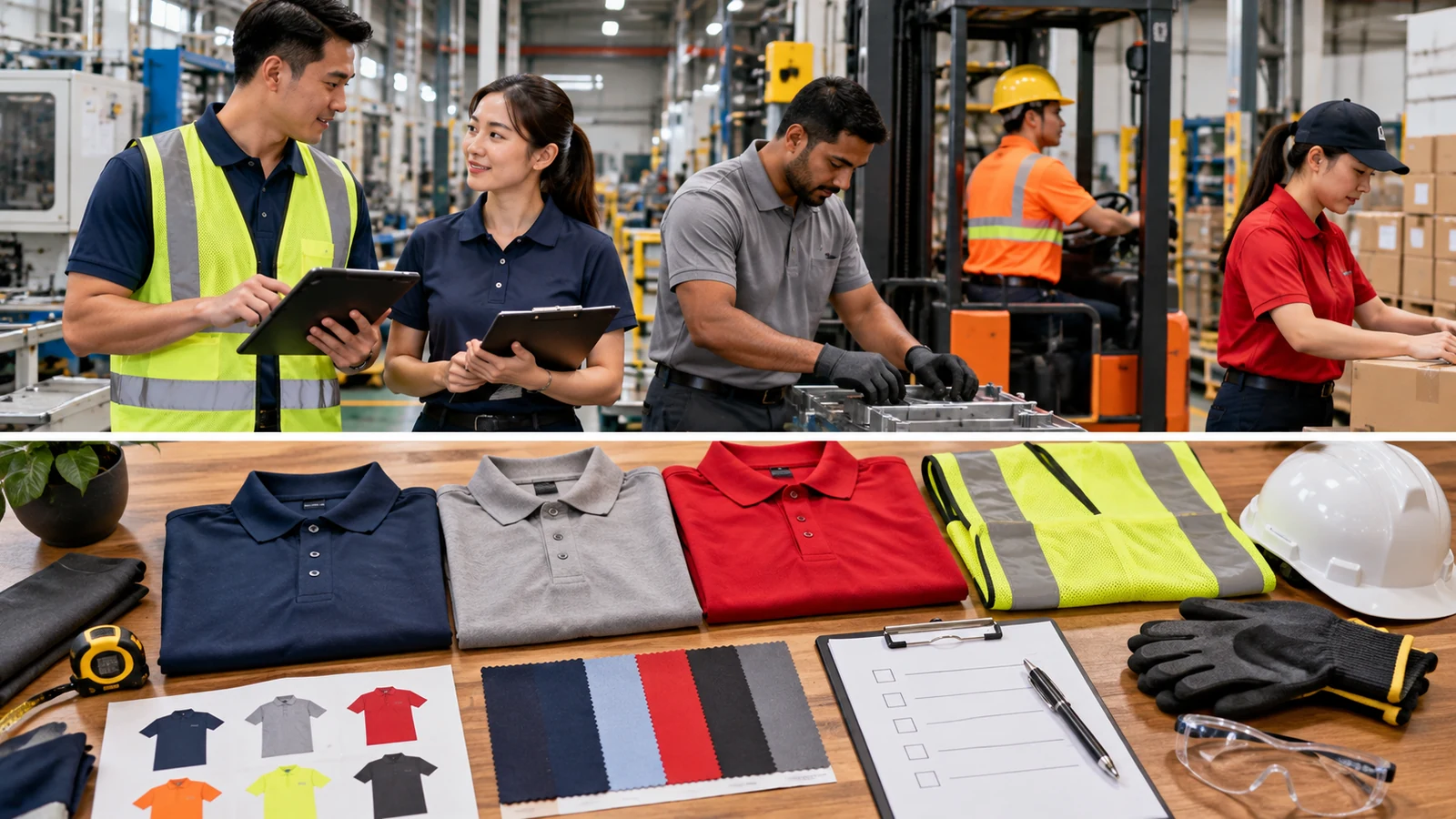
Record the approved garment code, colour, size range, logo method, logo position and any role marker in a one-page issue guide. Add a revision date and an owner for changes. For contractors, specify whether they use the same base garment, a separate vest or their own compliant workwear.
The document should be usable by a storekeeper who was not part of the original uniform project. That is the test of a scalable system. If repeat orders depend on someone remembering which shade or logo size was used last year, the specification is not yet controlled enough for multi-site operations.
For Sarawak industrial teams, a scalable workwear system is one that can move with people and projects: common base garments, clear role markers and separately specified safety layers.
Frequently Asked Questions
Should contractors wear the same colour as employees?+
Only if that supports the site identification system. Some sites deliberately distinguish contractors; the rule should be documented and operationally meaningful.
Is a bright polo a substitute for high-visibility PPE?+
No. Safety apparel should be specified according to the worksite risk and applicable requirements, not inferred from brand colour.
How can branches reduce dead uniform stock?+
Use common base garments where practical, limit colour variants and keep role-specific identifiers separate when they can be replaced more cheaply.
Need a controlled workwear specification for Sarawak teams?
UniformSarawak can help structure ready-made garments, branding and repeat-order specifications for multi-role teams.
Discuss Your Workwear Requirements